Santa Clara UMC is the single oldest Protestant congregation in California. In 2026 we shall commemorate the Methodists' landing in our Valley as dated October 16th, 1846 by Margaret Hecox's in her journal. The Rev. Sanders called it, "The first Protestant Church West of the Mississippi". As a Protestant church, we have a Wesleyan inheritnce.
As a Methodist mission station we've built great institutions like the University of the Pacific & Liberty Towers. Our charitable impact includes local parks, orchards, roads, bayside warfs, government legislation, fraternal lodges, mineral mines, street names, neighborhoods and homes. More information and quotes about our beginnings as the first Protestant congregation in Alta California have been cojmplied here.
Some of the earliest founders who arrived by wagon train in 1846 are Judge Adna Hecox and his wife, Margaret (Margaret recorded their journey in her diary, later published under the title, California Caravan); Cpt. Joseph Aram and his dauther, Sarah (who married the Rev. P Cool, serving in Berryessa); James Reed, survivor of the tragic Donner Party; William and Benjamin Campbell, founders of the nearby town also called 'Campbell'. Others include Agnes Hancock and Silas Bennett. In 1847 further emigrants arrived, augmenting methodist numbers and gifts, most noteably Elihu Anthony, Charles Campbell. In the same year likewise came the Rev. William Roberts, first superintendent of the Oregon & California Conference.
Contact us for other Archival, Plaque, or Commemoration information, collected by SCUMC's Anniversary & Community Committee.
One-Hundred Eighty Years & Beyond
Methodism from Sea to Sea
Methodism began with John and Charles Wesley who had roots in the High Church Religious Societies in early-18th century England. These clubs regulated a high sacramentalism, endearing their members to the established Anglican Church. While employed by the SPCK/SPG in colonial Georgia, Wesley met German Moravians.
Wesley was highly impressed by Moravian steadfast devotion. He soon introduced their discipline and practice into High Church circles, first in London, then Bristol, and Kingswood. Such was the rise of Methodism. Wesley explained Methodism's consequent expansion across the Atlantic in Sermon 63:
"It then spread into North Britain and Ireland; and, a few years after into New-York, Pennsylvania, and many other provinces in America, even as high as Newfoundland and Nova-Scotia. So that, although at first this "grain of mustard- seed" was "the least of all the seeds;" yet, in a few years, it grew into a "large tree, and put forth great branches." "
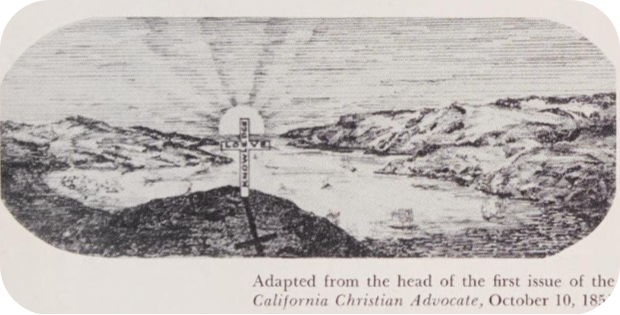
After the War of Independence, Methodism was fully organized in Baltimore. By the labors of traveling preachers and other pious settlers, it spread rapidly from the eastern seaboard across the American frontier. In 1834 a Methodist mission began in the Willamette Valley of Oregon. By 1846 it arrived in Alta California: first, in San Jose by dint of J. Aram's wagon train, and then in San Francisco by W. Roberts' arrival by schooner.
Between 1847-1850 the Oregon conference supplied northern California with pastoral oversight. The earliest missionary superintendents were the Revs. Roberts, Owen, and Taylor. Rev. William Taylor is remembered as one of the greatest missionary bishops whoever traversed the globe, yet his work started with methodist people in Monterey, San Jose, and San Francisco.
Both Alta California and the Oregon Country initially belonged to the foreign missions field before they established their own individual, statewide Annual Conferences. After Methodism's organization on westcoast, California, again, advanced missionary work as a natural gateway to Hawaii, much of Oceania, and the wider Orient. Overseas work was greatly helped by the Methodist Woman's Foreign Missionary Society (WFMS).

In 1851 the California Conference was fully instituted. The new Conference quickly became self-sufficient and influential, largely due the distance of California to New York, but also from the gush of wealth generated by Gold Discovery. The ME Church eagerly founded California colleges like University of the Pacific, MacClay College, Pacific Methodist, and even University of Southern California.
Among the numbers of families that arrived with Captain Aram's wagon company, were several Presbyterians from the Cumberland church. These people joined the methodists, making the first meetings in Santa Clara and San Jose. Later, during the Great Depression, Presbyterian and Methodist congregations reunited as an ecumenical Federated Church, separating again after WWII.
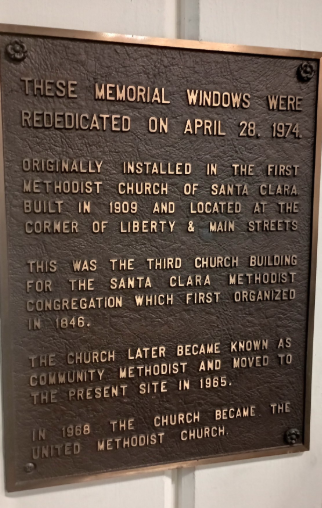
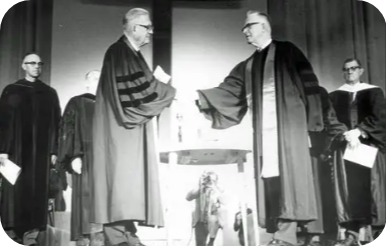
In 1965 our church moved from Santa Clara's old downtown (the Old Quad) to our present location, next to Lincoln St./ Warburton Aves. On April 23, 1968 we became the United Methodist Church. Yet, as a '46er church, we've played a unique role in the history of Santa Clara, its surrounding Valley, the rest of California, and even the Pacific.

-
Location